
Lithuanian desserts are a tasty expression of the country’s love for simple, hearty ingredients, particularly curd cheese, butter, honey, apples, poppy seeds and biscuits. Some are elaborate celebration cakes that can take hours to prepare, others are humble homemade treats that involve a few ingredients and a little mixing. Lithuanian sweets also have a strong seasonal aspect, some of them are closely associated with Christmas, weddings and other festivities. These are the Lithuanian desserts to look out for when exploring Lithuania, from the famous tree-shaped šakotis to the wonderfully simple tinginys.
Tinginys

If you can only have one Lithuanian dessert, it’s tinginys. Literally, the name translates to “lazy” or “sloth,” and it’s a good one for a cake that doesn’t need any baking. The traditional tinginys is prepared by mixing biscuits, cocoa, butter and sweetened condensed milk together, forming the mixture into a shape and letting it set. The result is dense, chocolatey and slightly chewy, somewhat reminiscent of chocolate salami. Modern versions may contain caramel, nuts, dried fruit or pistachios, but the biscuit pieces are still a significant part of the cake.
Though it’s simple, tinginys is a great example of Lithuanian home baking: cheap ingredients made into something that’s good enough to be a national favorite. It is typically served with coffee or tea, and is more of an afternoon snack than a dinner dessert.
Šakotis

Whereas Lithuania’s lazy dessert is tinginys, its spectacular showstopper is šakotis. This festive cake is called roughly “sha-ko-tis” and is very similar to a tree, with branch-like projections. It is traditionally linked to celebrations, and is so integral to Lithuanian cuisine that Lithuania even has a museum dedicated to the cake.
The odd look is due to an equally odd cooking technique. A thin batter, consisting of flour, eggs, butter, sugar and sour cream, is poured or brushed onto a rotating spit over an open fire, and repeated several times. The batter drips down as each layer cooks, creating the characteristic spikes and branches. The cake is crispy on the outside and soft on the inside.
The preparation takes time. The long baking time of large šakotis is one of the reasons why the cake is traditionally linked to weddings, holidays and big family events, which can take several hours to bake. It’s not just a sweet to serve at the table, it’s a showy and meticulously prepared event.
Varškėčiai


Lithuania is a big fan of varškė, the country’s traditional curd cheese, and varškėčiai are one of the best examples of it. They are small, thick curd-cheese pancakes that have a nice tangy taste and a nice soft and substantial texture. They are typically served with a sweet or creamy accompaniment, like fruit, jam, applesauce or sour cream.
Varškėčiai are commonly consumed for breakfast, but Lithuanians don’t appear to be too worried about breakfast being the only time of day for pancakes. They make a great dessert or afternoon snack, particularly when topped with a large scoop of sour cream and fruit preserves, and served warm.
They are characterized by the curd cheese. Varškėčiai are thicker and more substantial than a fluffy American-style pancake, and have a mild dairy tang that complements the sweetness of the toppings.
Grybukai

Don’t be fooled by the name. Grybukai translates to “little mushrooms” but these little Lithuanian sweets have no mushrooms in them. Rather, they are mushroom-shaped cookies that look like something you may have just picked up from the woods. They are traditionally soft, cake-like stems and crisp meringue-style caps, and are often flavoured with cocoa to darken their colour and taste.
The mushroom-like appearance is no gimmick. Mushroom picking is a tradition in Lithuania, especially in the forests, and grybukai have masterfully transformed this old forest image into a sweet. They are frequently packaged in small wooden or cardboard boxes, which gives them the appearance of having just fallen from the forest floor.
Grybukai are typically small enough to be eaten in one bite or two, and are perfect served with coffee or tea. They may also differ significantly in flavor and decoration, with modern versions incorporating various fillings, coatings or flavoring.
Varškės Spurgos


Lithuania’s love affair with curd cheese extends to varškės spurgos, curd-cheese doughnuts. These are quite different from the fluffy glazed doughnuts familiar in North America. The curd cheese is added directly to the dough, which results in a slightly tangy taste and a soft, but pleasantly chewy texture inside the sweets, with a crisp, fried outer layer.
The ingredients of the dough are traditionally curd cheese, eggs, flour, sugar and a pinch of salt. They are formed into little balls and deep fried until they are golden, then sprinkled with powdered sugar. Some versions are completed with honey, providing an additional layer of sweetness.
They are especially soothing on a chilly day and are a great accompaniment to coffee or tea. Their popularity is due to the contrast, crisp on the outside, soft on the inside, tangy dairy taste, and lots of powdered sugar on top, like many Lithuanian sweets.
Obuolių sūris

At first glance, the English translation sounds rather strange. Apple cheese sounds like a pretty unappealing dish, particularly since there’s no cheese in it. However, obuolių sūris is one of the most unique traditional Lithuanian desserts and a great example of how simple ingredients can make something surprisingly tasty. The dessert is prepared by cooking apples slowly for hours until they are an extremely thick fruit paste.
Sugar or honey is added to make it sweet, and cinnamon and sometimes nuts like walnuts are added for extra flavor. When the mixture has been reduced sufficiently, it is pressed into a loaf or round form and allowed to mature until it is firm enough to cut. The final texture is somewhere between fruit leather, quince paste and a thick jelly. High in apple taste but not too sweet, it is frequently paired with tea or served as a little snack after dinner.
Varškės pyragas

Varškė is the one ingredient that characterizes Lithuanian desserts. This is a new curd cheese that is used in numerous sweet dishes, and varškės pyragas is perhaps its most popular cake. Many people just refer to it as cheesecake, but Lithuanian curd cake has a distinctly different flavor. It is not made with cream cheese, but with fresh curd cheese, which makes the cake lighter and slightly tangy, and wonderfully bouncy.
The inside is soft and moist, but not as soft as a typical New York cheesecake. There are different recipes in different households. Some versions have a thin pastry crust, raisins, vanilla or lemon zest; others do not have a crust at all. A good amount of sour cream, which is slightly acidic, is a perfect match for the sweet curd, and is one of the most traditional ways to serve it.
Enjoying this post? Then you may also like our guide to Russian desserts and Turkish desserts.
Riešutėliai

These little cookies are extremely addictive. They are called little nuts, and they are indeed as small as little nuts, and as small as walnuts. Riešutėliai are made using two semi-soft cookie halves baked in special walnut-shaped molds. After cooling, the shells are stuffed with a rich cream of condensed milk, typically caramelized sweetened condensed milk, which is similar to dulce de leche. Butter is sometimes added to the filling to make it smoother.
They are particularly favored for birthdays, weddings, Christmas and family events, as they can be made in bulk. It’s very easy to eat several of them before you realize how many have been consumed, as they are bite-sized.
Pyragaičiai svajonė

Pyragaičiai svajonė means dream cakes, and it’s a pretty good description once you taste one. They are small individual cakes, usually with a soft sponge or cake base (made from yoghurt) and a fruity filling. They are then covered in a generous layer of dried coconut, which gives them a delicate snowy look and a nice texture to the outside. These are not fancy celebration cakes, but rather cakes to be eaten in small bites. They are light enough to be served with afternoon coffee and sweet enough to be eaten as dessert, so they are very popular in Lithuanian pastry shops.
Blini
Blini are a popular and well-known dish in Lithuania, but they are also part of the broader Eastern European cuisine. Blini are thin pancakes made from wheat flour or buckwheat flour, milk, eggs and sometimes yeast. They can be wonderfully thin or slightly thicker and fluffy, depending on the recipe.
The versatility of toppings and fillings is what makes them so versatile. Sweet blini are served with jam, honey, berries, cottage cheese or sour cream, and savory blini are served with mushrooms, smoked salmon or minced meat. They are often served at breakfast, brunch or as a cozy weekend dinner in Lithuanian homes.
Funnel Cake

Although not uniquely Lithuanian, variations of this popular fried dessert are found all over the fairs, festivals and outdoor events in Europe. It’s a brilliant idea: a loose mixture of flour and egg is poured into hot oil in thin streams, forming a web of crispy fried dough. It is originally gold colored and then covered with copious amounts of powdered sugar and sometimes fruit preserves or chocolate. It is most attractive for its texture. The exterior is wonderfully crisp and the delicate strands are surprisingly light and airy on the inside. Best eaten fresh and hot.
Kibinai

Kibinai are arguably Lithuania’s most famous pastry, though they are savory, not sweet. No trip to Lithuania is complete without trying one. The crescent-shaped pastries were introduced to Lithuania by the Karaim community, a Turkic ethnic minority whose cultural centre is the picturesque lakeside town of Trakai.
The traditional kibinai are stuffed with chopped mutton, onions and herbs, but modern versions include beef, chicken, mushrooms, cabbage, curd cheese and even sweet stuff. The pastry is rich and buttery, resulting in a beautiful flaky crust that is contrasted with the juicy filling. They are usually consumed hot with a cup of broth or traditional kvass.
Napoleonas (Lithuanian Mille-Feuille)

Lithuania’s version is called Napoleonas, and is one of the nation’s most popular celebration cakes, known internationally as mille-feuille. The dessert is made up of many extremely thin layers of crisp puff pastry and silky vanilla pastry cream. Some Lithuanian versions feature a slightly tangier cream, which is flavored with butter, while others are more towards a lighter custard filling.
The key to the recipe is the incredible texture of the flaky pastry and smooth cream. In the twentieth century, Napolean became firmly entrenched in Lithuanian baking culture and is one of the first cakes ordered for birthdays, holidays and family gatherings.
Poppy Seed Roll

The poppy seed roll is one of the best examples of the use of poppy seeds in Lithuanian baking, which has been an important part of Lithuanian cuisine for centuries. This sweet roulade is locally known as aguonų vyniotinis and starts with soft yeast dough, rolled around an extremely copious amount of finely ground poppy seeds, sugar, butter and sometimes honey or raisins.
The filling is wonderfully dense when baked, making beautiful dark spirals when cut. It is flavorful, with a slightly nutty and pleasant bittersweet taste, not too sugary. It is particularly favored during Christmas, Easter and other significant events when poppy seed desserts are common on family tables.
Enjoying this post? Then you may also like our guide to Estonian food.
Skruzdėlynas

Skruzdėlynas is one of the most impressive Lithuanian desserts. This is a very tall piece, which appears almost like an architectural structure, constructed from dozens of fragile fried pastry pieces. The dough is prepared with flour, eggs, salt and sometimes sour cream and then rolled very thin. Small rectangles are cut, fried crisp, and carefully piled into a tall pile.
Lastly, it is coated with a shiny honey syrup that’s flavored with butter and sometimes sour cream, and then sprinkled with poppy seeds. In the past, skruzdėlynas was connected with Lithuanian beekeepers and late-summer honey harvest, and honey became the main ingredient of the dessert, both symbolically and gastronomically.
Kūčiukai

Kūčiukai are more than just a dessert, they are one of the most important Christmas traditions in Lithuania. The dough for these little hazelnut-sized biscuits is very simple, consisting of flour, water, yeast, sugar and lots of poppy seeds. After baking, they are crisp and delicious by themselves. However, tradition calls for something much more special. Kūčiukai are served on Christmas Eve in aguonų pienas (poppy milk).
This strange beverage is made by crushing soaked poppy seeds and blending them with water and a bit of sugar to make a creamy, fragrant concoction. This is served at the traditional twelve-course Christmas Eve meal, around the family table. In addition to its taste, kūčiukai are a token of memory and hospitality, and traditionally were offered to the spirits of the ancestors who had passed away.
Šimtalapis
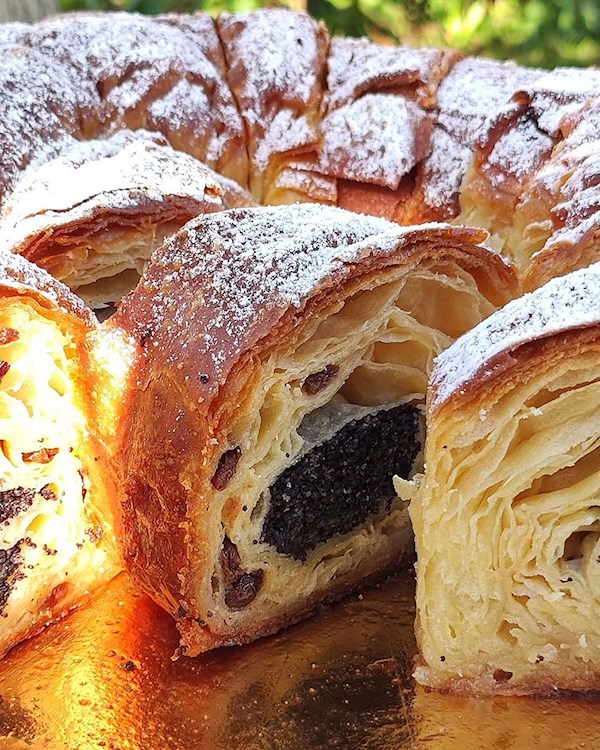
Literally translating to hundred leaves, šimtalapis is one of the richest and most celebrated cakes in Lithuania. It is closely related to the cuisine of the Lithuanian Tatars, who have lived in the country for centuries and have left their mark on the local cuisine. The cake is made by spreading the yeast dough into very thin layers, and then filling them with melted butter, sugar, poppy seeds and raisins, rolling, twisting and baking the dough into a beautiful spiraled cake. The outcome is rich, creamy, fragrant and surprisingly satisfying. Each slice is filled with dozens of fine layers of sweet poppy and plump raisins, and is a popular wedding and family event dessert.
Varškės sūrelis

Varškės sūrelis is one of the most popular Lithuanian confections, a chocolate-covered curd treat that is eaten by all ages. The bars are made from sweetened soft curd cheese, formed into a small rectangle and then covered with a thin layer of dark or milk chocolate. The classic vanilla flavor is still available, but there are also new flavors such as cocoa, poppy seeds, pistachio, caramel, condensed milk centers, and chocolate chips. Sūrelis is a treat for everyday, not for special occasions like elaborate cakes. It is commonly consumed as a breakfast item, as a snack in the afternoon, or with coffee as a sweet treat without taking the plunge into a full dessert.
Zefyrai

Zefyrai are a class all on their own. They are not cookies, marshmallows, nor meringues, but they are all a bit like them. These elegant sweets are made by whipping fruit purée together with sugar and egg whites before stabilizing the mixture into soft airy domes.
The two identical parts are then pressed together to form the iconic shell shape. It is very light, fluffy and has a mild fruity taste, depending on the fruit used. Apple is particularly traditional, and raspberry and berry are also popular. Many modern zefyrai are dipped in chocolate to give a delightful contrast of crisp chocolate and cloud-like filling.
Žagarėliai

To many Lithuanians, žagarėliai are a taste of childhood. The beautifully twisted pastries are called angel wings and are one of the most nostalgic homemade sweets in the country. The flour, eggs, butter, sugar and a little salt are mixed together to make the dough, which is then rolled very thin. A slit is made in the center of the small strips and one end is carefully pulled through the slit to form the characteristic winged shape.
The pastries are then fried, making them very crisp and light, and then covered with a copious amount of powdered sugar. They are light and crunchy, and are virtually impossible to stop eating, especially when paired with tea or coffee during family visits or holiday gatherings.