
Even though Europe’s street food scene might not be as rich and popular as India or most Asian countries, there are a lot of tasty street food delicacies that are worth trying. In this post, we’ll focus on the traditional piragi recipe (bacon pie recipe); a street food treat that comes from Latvia, but is famous in other countries in the Baltic region. To be honest, the Baltic is probably not the best street food destination in Europe but there are a few street food delicacies that are definitely worth trying. Piragi (pīrāgs in Latvian) is one of them!
But first, let’s cover some basic things you should know.
What is Piragi (pīrāgs)?
The best way to describe piragi is as traditional Latvian bacon buns (or breads filled with salo). It has a similar name to Russian piroshki, but these are two different snacks. In Latvia, piragi is more than just food. In Latvia, the piragi recipe is a slice of tradition. The buns are small and have the shape of a torpedo. Inside, they’re filled with chopped bacon and onions. They’re really easy to make but yet delicious. You can find them anywhere, including street food stalls, bakeries, and restaurants, but also, a lot of people prepare them for important holidays, like Christmas Eve and Jani (Midsummer Day).
Origins

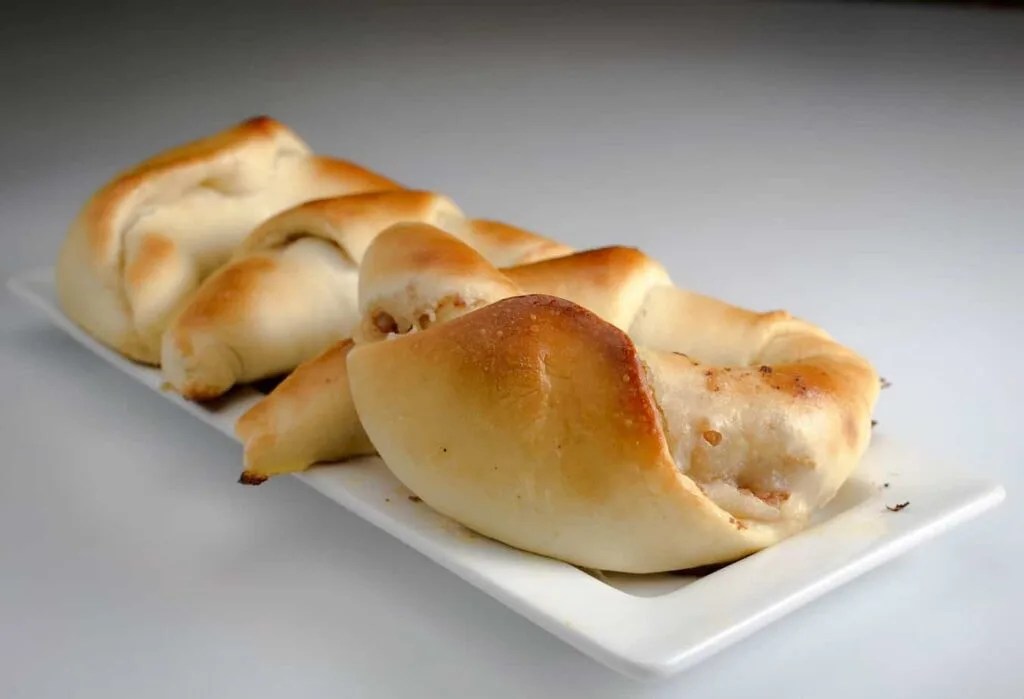
Traditionally, Latvian cuisine mostly consists of meat and fish dishes with some seasonal agricultural ingredients, such as potato, onions, cabbage, and wheat, and piragi is a prime example of this. All of the main ingredients (flour, bacon, and onions) are not seasonal and are one of the only handful of things that can (and historically could) be found in Latvia throughout the year. Hence, it’s easy to see how this simple yet delicious delicacy became so popular in the tiny Baltic country.
In different regions of Latvia, you’ll hear people referring to the traditional piragi recipe with different names, such as speķa rauši, speķa pīrādziņi, speķa pīrāgi, or speķrauši, but all of these variations loosely translate to fat meat pie (in a diminutive form). The traditional piragi recipe has a moon-shaped form and has bacon, but as you can see below, there are some variations to this.
Piragi is usually eaten as an appetizer or with a stew (like bigos) as a light lunch. Their size can vary between 2 and 6 inches. The smallest piragi are usually found in restaurants or famous bakeries because the smaller the piragi, the more skill is required to make it.
Enjoying this post? Then you may also like our Karjalanpiirakka recipe.
History


Historically, bringing piragi to celebrations and holidays has been seen as a sign of bragging or boasting ( but not in a bad way). People in Latvia have always served piragi to show and celebrate that they have been blessed with a bountiful harvest and healthy livestock. Traditionally, piragi is always served on Jani, an old pagan holiday devoted to the Latvian pagan god Janis as a way for locals to show their gratefulness and appreciation of the God of Summer.
Jani is celebrated even today (known as Jani) on 23/24 June, and piragi are still served, but because of the progress in the fields of agriculture and animal husbandry, we can enjoy this delicious treat throughout the year.
Variations
The piragi recipe has two main variations: one is a plain yeast bread dough, and the other is made of flaky butter dough. In addition to these two variations, people have gotten creative throughout the years, and today, you can find a lot of varieties of the piragi filling. The most common filling features ground beef, chicken, fish, or ham (instead of bacon), and/or cheese, potatoes, carrots, etc. At some places, you can even find sweet piragi with strawberry or blackberry filling.
A Few More Tips


When preparing this traditional Latvian bacon pie recipe, there are three steps: dough, filling, and putting both together.
As for the dough, the key difference with piragi dough is that, because of the milk and sugar used in making it, the dough is usually richer than what you might be used to. For starters, the yeast has to be mixed with warm milk and sugar.
Once it starts bubbling up, sift some flour to get rid of the clumps that might appear. After the yeast is active, add it to the flour and stir all the other ingredients together.
When making your filling, pre-cook the bacon or keep it in the freezer for 10 minutes, so that it’s easier to cut it into tiny pieces.
Grease your baking sheet before adding the dough and top it with stirred raw egg.
Piragi Recipe


In this post, we’ll focus on the traditional piragi recipe (bacon pie recipe); a street food treat that comes from Latvia, but is famous in other countries in the Baltic region.
Ingredients
Dough
- 7 Grams Yeast
- 350 Grams Flour
- 50 Ml Warm Water
- 1 Egg (beaten)
- 60 Grams Butter
- 3 Teaspoons Salt
- 6 Teaspoons Sugar
- 150 Ml Milk
Filling
- 300 Grams Bacon
- 2 Onions (diced)
- 2 Teaspoons Ground Pepper
- 3 Teaspoons Salt
- 1 Egg (beaten)
Instructions
1. Sauté onions and bacon in a pan until the onions get brown and most of the bacon fat is fried.
2. Add some ground pepper.
3. Let the mixture cool off while preparing the dough.
4. Add the yeast and water in a small bowl.
5. Add butter, milk, and sugar in a small saucepan and warm the mix on a low heat until the butter melts.
6. Mix the flour and salt in a large bowl.
7. Pour the water and stir.
8. Let the dough rest for 10-15 minutes.
9. Knead the dough for 10 minutes until it becomes smooth and elastic.
10. Let the dough rise for around 1 hour.
11. Preheat oven to 180 degrees Celsius (360 F).
12. When the dough is done, pull off tiny pieces of dough, place a tablespoon of the filling and work the dough into a ball.
13. Fold the dough to the other side and tuck it underneath the filling, making a crescent moon shape. Pinch both sides together to extend the piragi.
14. Place the buns on a baking tray lined with baking paper.
15. Brush the beaten egg on the buns.
16. Put the buns in the oven and bake until they become golden.
17. Serve and enjoy.
Notes
You can also freeze Piragi after it cools down and serve it a few days later.
Nutrition Information:
Yield:
20Serving Size:
56 gramsAmount Per Serving: Calories: 171Total Fat: 10.2gSaturated Fat: 3.7gTrans Fat: 0.3gUnsaturated Fat: 1.2gCholesterol: 29mgSodium: 249mgCarbohydrates: 14gNet Carbohydrates: 14gFiber: 0.7gSugar: 1.4gProtein: 4.8g
A Few Things You Might Need

Mixing Bowls


Baking Pan


Rolling Pin
Did you ever try piragi? How did you like our piragi recipe? Feel free to share your thoughts in the comments.
Like it? Pin it.


Fern
Wednesday 16th of October 2024
First thank you for all the background info as well as a very thorough recipe.
I helped my Mom-mom make these buns as a child- as we all did, gathered around the worktable in her tiny kitchen (amazing how many could fit in there). She would literally make hundreds, for my family, holidays, weddings, church suppers, you name it.
Once you but into one you were powerless to stop there. They were so tasty and satisfying.
The funny part for us is that we always called them ”Speckroaches"! It was probably someone's older-days prank, sounding more like the name of a bug than a heavenly delicious treat.
Over the years many in the family (and outside it) made their own variations, often to make this simple recipe even simpler.
I just had to write this love-letter to Latvia, from which my great-grandparents emigrated, bringing this recipe across the ocean with them.
I can still taste the warm bacon-onion filling in my mind. Mmmmm!
Karīna
Saturday 23rd of August 2025
@Fern, That's probably from speķrauši, pronounced similarly to how you would say speckroach, probably just direct translation of the way it sounds. Speķrauši/rausis means also speck pie and is another name for this pastry.
Daniel Kiteski
Wednesday 20th of November 2024
Thank you so much for sharing this beautiful memory! It’s amazing to hear about your Mom-mom’s dedication and how these buns brought everyone together in her tiny kitchen—what a heartwarming image! I love the name “Speckroaches” and the humor behind it; it makes the tradition even more unique and special.
Your love letter to Latvia and the memories tied to this recipe are truly touching. It’s wonderful how these buns have become such a cherished part of your family’s story, connecting generations and carrying flavors of the past.