There aren’t many better ways to explore a new destination and its culture than trying some of its most popular street food. And in Greece, street food is a way of life, not just a simple dish. Most Greek street food dishes consist of simple, easy-to-make but delicious recipes that will leave you craving for more. In other words, Greece is like a giant, tasty labyrinth whose only exit is eating one’s way out. I have been fortunate enough to spend a fair amount of time in Greece, travel across the country, and taste hundreds of different street food in Greece, and in this post, I’ll share my 22 favorites.
Gyros are the ultimate street food of Greece—succulent, flavorful pork, beef, or chicken that is slowly roasted on a vertical spit and sliced into thin pieces. They are served inside a warm pita wrap with tomatoes, onions, fries, and a generous amount of tzatziki sauce. The word “gyros” is the Greek equivalent of “turn”; hence, the meat was described as the one that rotates during the cooking process.
Although it shares with Turkish döner kebab some similarities, gyros, as we know them, became a hit in Greece only after the 1920s, following the population exchange with Asia Minor. It is true that gyros can be found everywhere, even from islands to mountain towns, although Athens and Thessaloniki are mostly recognized for their night-time gyro places.
Souvlaki
Souvlaki is a quintessential Greek dish that is famous worldwide, which consists of chunks of pork, lamb, or chicken, (but there are also modern versions like the salmon one) skewered and grilled over hot charcoal. The word comes from the medieval Greek word souvla, which means skewer, and it’s an ancient recipe that was first discovered at Mycenaean sites. Souvlaki is generally consumed directly from the stick, which makes it a perfect street food snack. It’s especially popular in Central Greece and the islands, and locals often grab one during lunch breaks, after late nights out, or just while strolling the streets.
Greek Burgers – Biftekia
Biftekia are the Greeks’ equivalent to burgers, but of course, with a local twist. These thick, well-seasoned patties are definitely the best option if you want to avoid standard fast food. They are typically made from ground beef or lamb that is mixed with onion, garlic, parsley, oregano, and sometimes with milk-soaked breadcrumbs. They are sometimes also filled with cheese (such as feta or kasseri) and then grilled over charcoal until they are hot and juicy.
The reason that biftekia are just Greek is the seasoning—Mediterranean herbs and olive oil usage give them a fresh, grassy taste. They are generally accompanied by pita, lemon wedges, and a side of tzatziki or tomato rice. Biftekia from Thessaloniki and Northern Greece will be among the best you’ll ever get, usually as part of a meze platter in street-side tavernas. Unlike the American burger, biftekia are not eaten with buns; they are only part of a bigger meal or they are wrapped up to go.
Spanakopita
Spanakopita is a Greek savory spinach pie that’s one of the most popular street food in Greece. The pie is made by wrapping a deep spinach and feta cheese filling with lots of thin layers of phyllo dough. The dish was originally from the rural areas where the local women went foraging for wild greens, and they also used the phyllo technique (which was brought by the Ottomans) to make dough for their meals, thus creating simple, nourishing, and portable meals.
Today, you can find it in almost every Greek bakery, and it’s one of the most popular choices for a quick breakfast on the go. In Northern Greece, especially in Epirus, you can find the versions that are rustic and handmade and are baked in wood-fired ovens.
Tiropita
Tiropita is a traditional Greek cheese pie made of layers of crispy butter phyllo filled with different kinds of cheese, mainly feta, sometimes combined with ricotta, graviera, or anthotyro. The word itself means “cheese pie,” and it is often folded into small hand-held triangular shapes to be easily consumed as street food; however, it can also be found in spirals or slab-style trays. This dish is initially found in Thessaly and Central Greece and is one of the most popular items in bakeries.
It’s very similar to spanakopita and is also normally served either cold or hot, and does not require cutlery- perfect for street food. There is even a variation called strifti tiropita in Northern Greece, which is spiral-shaped. Today, Tiropitas are available everywhere in Athens, Thessaloniki, and traditional mountain villages, with each regional version being slightly different but still very delicious, flaky, and satisfying.
Kreatopita, or Greek meat pie, is a heavy pastry that’s especially popular in Epirus and the Peloponnese. It consists of layers of thin phyllo pastry that are filled with minced or shredded meat—usually beef, lamb, or pork—besides onions, herbs, and sometimes, rice or béchamel sauce. In the past, kreatopita was often made in large pans and cut into square slices, but today, it can be found as a street snack in most bakeries, markets, and roadside eateries.
One thing that differentiates it from other pies is that it is the use of local ingredients and the ample seasoning—oregano, cinnamon, or cloves are sometimes added for depth. The best ones are definitely in Ioannina or highland villages, where it is still handcrafted from scratch.
Dakos
Dakos is a very typical Cretan dish that goes beyond the traditional street food and meze types. It’s basically the Greek version of the Italian bruschetta- a snack made from a barley rusk (known as paximadi) lightly soaked either in olive oil and topped with chopped tomatoes, crumbled feta or mizithra cheese, oregano, and olive slices.
Simple as it may be, dakos is a taste explosion of texture and flavor—crispy, juicy, salty, and tangy all in one. A few modern versions even add capers or peppers, but the food still is consistent with the dish’s rusticity. During the summer, the dish is very trendy and can be eaten either as a snack or a light lunch with a beer or a glass of tsikoudia.
Dolmas
Dolmas, or dolmades, are grape leaves filled with rice, herbs, and in some cases, meat. While there are variations of the dish across the Balkans and the Middle East, Greece is the one that has definitely made the vegetarian version the most representative of the country, mainly during Lent or as a meze. Usually served cold with a piece of lemon or warm with avgolemono (egg-lemon sauce), dolmas are a market and bakery staple.
The recipe’s history can be traced to the Ottoman era, but alterations might have been present in ancient Greece, using fig leaves instead of grape leaves. Greek dolmas commonly contain dill, mint, pine seeds, and a splash of olive oil, which gives them a fragrant, slightly sour taste. Often, the best dolmas are made at home, but if you are in Northern Greece, for example, near Kavala or Thessaloniki, you will also find great ones.
Revithokeftedes
Revithokeftedes are chickpea fritters from Greece, similar to falafel but with a distinct Greek-Mediterranean influence. They come from the Cycladic island of Sifnos—a famous culinary destination for vegetarians that has given birth to a range of vegetarian fritters. This particular version is prepared by mashing chickpeas soaked in water with herbs such as parsley, dill, and mint, and then adding onion, garlic, and cumin for seasoning.
They are formed into little patties and fried until they become golden, served with yogurt or tzatziki sauce. In Sifnos, they can be found in bakeries, seaside tavernas, and also by mobile vendors who go to different places during festivals or market days. These fritters are mostly liked during fasting periods, thus becoming the main diet of Greek Orthodox cuisine.
Fritters (Tomatokeftedes & Kolokithokeftedes)
Speaking of fritters and street food in Greece, we have to mention the famous tomato fritters (tomatokeftedes) and zucchini fritters (kolokithokeftedes). Both of them are the main ingredients of island cuisine, especially in Santorini and Naxos. Tomatokeftedes are prepared from sun-ripened tomatoes, onion, herbs, and flour, then fried into patties.
They have a salty-sweet flavor and are very often served with yogurt or tzatziki. On the other hand, in kolokithokeftedes, the main ingredient is the zucchini; the mixture consists of grated zucchini with feta, mint, and dill—light, herbaceous, and slightly salty. The two versions can be found in tavernas on the beach and food stalls during local festivals. Typically, they are served hot and eaten by hand, which makes them ideal to eat on the move.
Kontosouvli
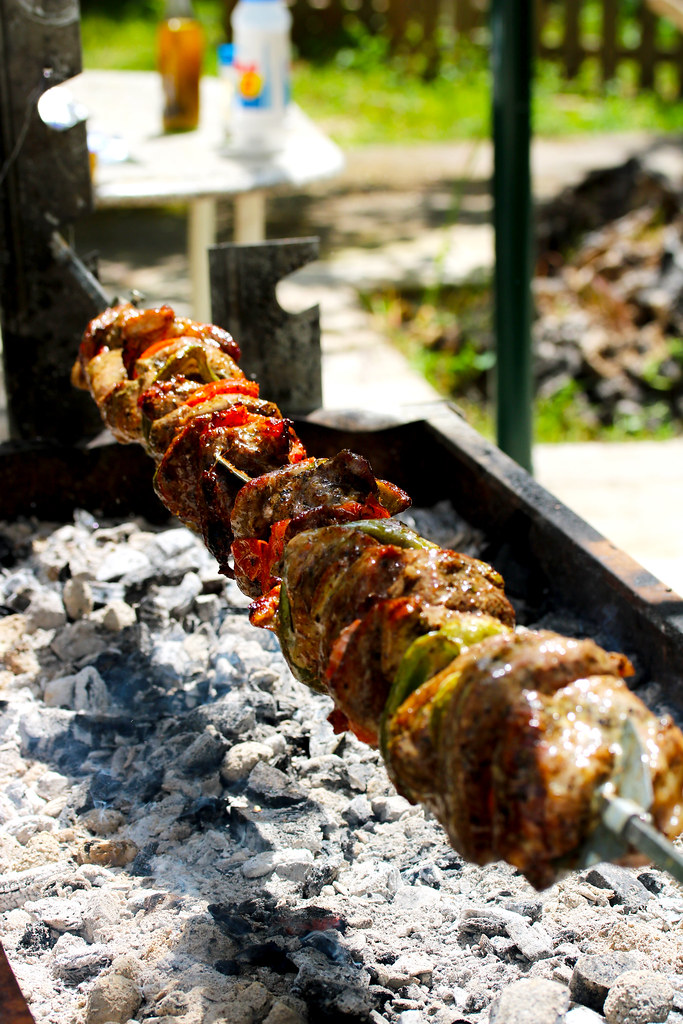
Kontosouvli is the epitome of carnivorous joy—huge cubes of pork (lamb is also used occasionally) that are marinated, threaded on a thick stick, and then slowly cooked over a charcoal fire. In contrast to souvlaki, which uses small pieces of meat, kontosouvli is meat with large chunks that become very juicy and crispy on the outside. The ingredients of the marinade are normally olive oil, garlic, oregano, lemon juice, and sometimes mustard or wine.
Kontosouvli comes from central Greece and the Peloponnese, and is a traditional Easter dish, but throughout the year, you can find it on street stalls and roadside grills across the country. Patras and Volos are the places that are known for their big and tasty kontosouvli portions, most of the time along with flatbread, roasted potatoes, or a squeeze of lemon.
Grilled Octopus
The grilled octopus (chtapodi sta karvouna)is a street food that is especially famous in coastal towns and islands such as Naxos, Syros, and Mykonos. The octopus is traditionally tenderized by beating it against rocks or slow-boiling and then char-grilled until it becomes a little crispy at the edges. Before serving in tiny portable bowls, it’s seasoned with olive oil, lemon juice, oregano, and sea salt.
You will come across it very frequently in harborside tavernas or beach shack bars, or eateries. These octopuses will be hanging so that they can dry in the sun before they are grilled—a picture as iconic as the recipe itself. Although it was traditionally the main part of a seafood meze platter, it can also be found in pita wraps or paper cones, if you are looking for a kind of street bite of the highest class.
Fish in a Cone
Fish in a cone is a street food snack that can be found in most seaside destinations, and even though it’s not originally a Greek invention, we feel this dish deserves a special mention on this list. Usually, this dish comprises small fried fish such as anchovies, whitebait, or calamari that are served in a paper cone, typically seasoned with salt, lemon juice, and sometimes herbs or paprika.
This grab-and-go snack provides a crunchy texture and a strong savory flavor that goes perfectly with on-the-go eating. Fish in a cone is very popular among seaside festivals and food trucks, and it is definitely best enjoyed when you eat it near the sea.
Grilled Sardines
Grilled sardines (sardeles sta karvouna) are a street food that’s a typical part of most local festivals (panigyria) on the islands and coastal villages. The sardines are only seasoned with coarse salt and then grilled whole. Most of the time, the grilling is done either directly on open flames or on iron grates. Before serving, the fish is usually drizzled with olive oil and a few drops of lemon to bring out the fresh, oily note of the fish. At the Sardine Festival in Kalloni (Lesvos), for example, the streets are full of smoke from the grill and stalls with paper-wrapped fish to be eaten.
Kokoretsi
Kokoretsi is a dish that’s not for the faint-hearted, but if you don’t know how it’s made, you’ll probably like it. It’s one of the most authentic Greek street food; it’s made from lamb or goat intestines wrapped around seasoned organ meats (like liver, spleen, and heart), skewered and roasted slowly on the spit over the charcoal. The outcome is a crispy, rich, and extremely flavorful sausage-like delicacy with a crunchy outer layer and a juicy, earthy inner part.
The dish is also available in most other southern Balkan countries, like Macedonia, Serbia, Bosnia and Herzegovina, Albania, and Bulgaria, but in Greece, kokoretsi is a celebratory dish that is usually offered in slices on paper plates with lemon and bread and traditionally served for Easter.
Koulouri Thessalonikis
Koulouri is a sesame ring bread (the Greek cousin of Turkish simit) that is crunchy on the outside, tender on the inside, and beloved everywhere in Greece. It is particularly popular in Thessaloniki, where it was first made. The bread is often likened to a bagel, but it is lighter, airier, and has a sesame flavor.
Koulouri is recorded in history to have originated in Byzantine times, and it was formerly sold by street vendors outside of churches. Nowadays, it has become a regular food for the locals who are on their way to work or school, and is often consumed with a cup of tea or coffee. Despite the new flavored versions being introduced, the traditional one is plain. The new versions are filled with a variety of things, such as cheese, olives, or even chocolate.
Tiropsomo
Tiropsomo, or “cheese bread,” is the tiropita’s fluffier brother- a very soft and pillowy bread that feels like feta cheese was spread throughout it. In comparison to the layered phyllo pies, tiropsomo is not in a pie shape but is baked as a loaf or roll and is very rustic, filling, and overly delicious. Most of the time, it is consumed at breakfast time or as a snack during mid-morning, and tiropsomo goes nicely with Greek mountain tea or coffee.
The product was initially made in the countryside where the leftover feta was baked into bread so that it was not wasted, and later on, it has been the main ingredient in the bakeries that are found all over the country. In regions like Arcadia or Central Macedonia, one will easily find it being sold either from carts or open-front bakeries, fresh and still hot.
Saganaki
Saganaki is a hot cheese dish that is pan-fried and named after the small two-handled pan it is cooked in. Generally, it is prepared with cheeses similar to kefalograviera, kasseri, or halloumi, and is fried until golden and crispy on the outside and smooth on the inside. Saganaki is frequently enjoyed with a glass of ouzo or brandy in the tourist tavernas, while the street version is served on its own.
Its history goes back to Northern Greece and Asia Minor, and it is still the favorite comfort food of many people throughout the country. A little lemon to the dish will bring an acid note, and its salty, oily flavor goes well with both beer and wine.
Peinirli
Peinirli is Greece’s take on the famous pizza: it’s a boat-shaped, uncovered pie with melted cheese inside, usually enriched with eggs, ham, sausages, or vegetables. The etymology of the name is the Turkish term for “with cheese” (peynirli). Peinirli is readily available in most Greek bakeries and roadside eateries, especially in Northern Greece and Athens districts populated by Pontic and Anatolian communities. One of the regions to highlight for peinirli is Piraeus, where small bakeries offer them freshly baked out of wood-fired ovens.
Loukoumades
Loukoumades are deep-fried dough balls soaked in honey syrup and dusted with cinnamon or crushed walnuts. It’s basically the Greek version of donuts. These insatiable sweet treats are said to have originated in ancient Greece, where they were given to victorious athletes as the “honey tokens.” They have become a favorite street dessert nowadays and are often sold from food trucks or pop-up stalls in public squares, especially during festivals.
The traditional way of preparing these involves deep-frying yeast dough until it is puffed and crisp, and then soaking it in warm honey syrup. Some of the contemporary changes also include chocolate, pistachio cream, or even ice cream as the topping. They are perfect when eaten hot, at the time they have the maximum crispiness.
Baklava
Baklava is one of Greece’s most iconic desserts— a pastry filled with honey and nuts and wrapped in layered phyllo pastry, crunchy, rich, and sweet with a syrupy touch. The pastry is baked until it reaches a golden color and then bathed in hot syrup of honey, lemon, and cinnamon. Its origin is not completely clear, but most scholars link it to the Ottoman Empire.
In Greece, Baklava has always been a dessert served during religious holidays and special occasions. However, it has gradually reached the street food scene, especially in Athens, Thessaloniki, and tourist-heavy islands like Rhodes and Crete. It is available directly from bakeries and dessert carts by the slice, and it is often packed for gifting purposes.
Bougatsa
Bougatsa is a breakfast pastry made with layers of flaky phyllo dough and a specialty of Thessaloniki and Northern Greece. It comes with either a sweet filling like a semolina custard dusted with powdered sugar and cinnamon or a savory one that contains minced meat or cheese. The dough is stretched by hand until it’s paper-thin, giving it a light, crisp texture that is different from any other pastry.
The sweet custard variety is the most liked one, because it can either be a soothing breakfast or a quick snack in the afternoon. Bougatsa is very frequent in train stations, bus terminals, and busy squares; in other words, basically anywhere there is foot traffic. If you haven’t had bougatsa with a frappe at sunrise in Thessaloniki, then you have missed out.
Roasted Chestnuts
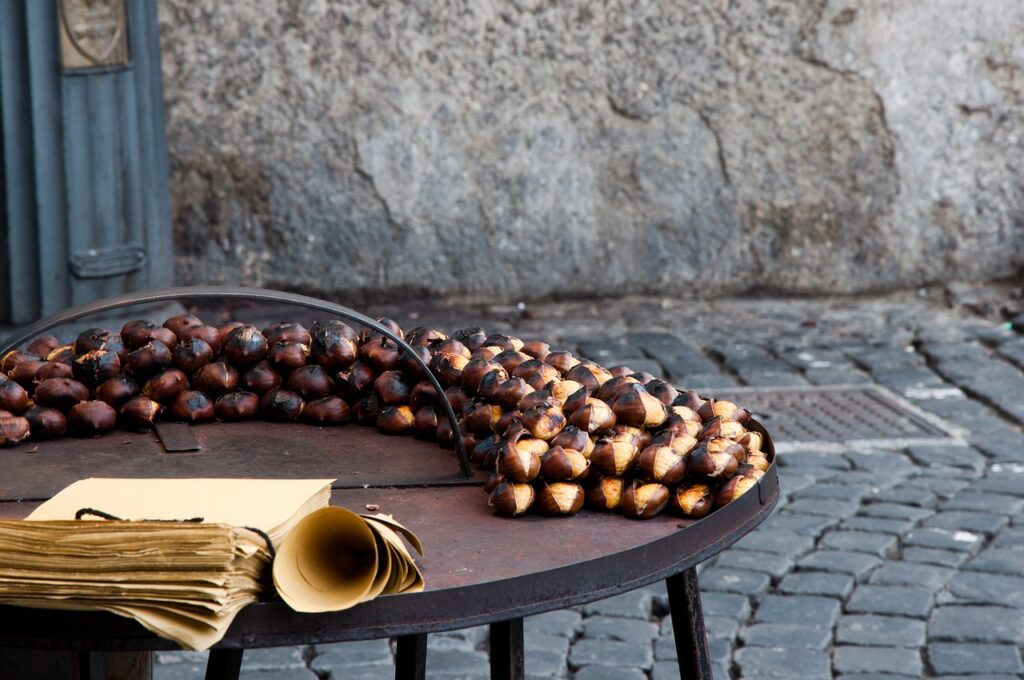
Last but not least, we conclude this list of the best street food in Greece with roasted chestnuts. In Greece, roasted chestnuts (kastana psita) are definitely the food of the past, but they are seasonal heroes that dominate the autumn and winter seasons. They are sold from metal carts with wood-fired ovens.
The vendors usually make the chestnuts easier to peel by scoring them before roasting, thus allowing the heat to get in. Roasted chestnuts were definitely the most favorite and common during the winter season in Athens’ Syntagma Square, Thessaloniki’s waterfront, and every major Christmas market. The roasted chestnuts are handed in paper cones and eaten hot from the cart.
How did you like this guide to street food in Greece? Do you know of any other street food snacks from Greece that deserve a mention on this list? Feel free to share your thoughts in the comments below.