
If you like dumplings and discovering different variations of them coming from different parts of the world, it’s probably a good time to learn about manti. In this article, we’ll share the traditional Turkish manti recipe and teach you everything there is to know about these delicious dumplings, including its origin, variations, preparation tips, serving tips, and more.
But first things first…
What is Turkish Manti?


The Turkish Manti is a dumpling dish that can be described as Turkey’s response to Italian ravioli or Chinese wontons, although it has a different taste. The main ingredients of manti are small dough parcels that are generally filled with spiced ground lamb or beef. Those can be either boiled and then baked, garnished with a yogurt sauce with garlic, and at the end, a drizzle of melted butter blended with paprika, sumac, or dry mint.
The manti is normally very small—it is said that the smaller the manti is, the more love and skills are used to make it. In Turkish traditional households, manti is not just about preparing the food- it’s a social event that mostly involves several generations of people who are folding the dough together at the kitchen table.
It’s usually served on special occasions or at holidays and evokes the image of Turkish hospitality, patience, and the art of traditional home cooking. It’s quite common to hear a Turkish saying that goes like, ‘If you love somebody, you make them manti’.
Manti Origin


The origins of manti extend to centuries and are located far beyond today’s Turkey. There is a wide consensus among historians that this food was first introduced by Turkic nomads of Central Asia, who spread the manti recipe along the Silk Road. These initial versions of manti were very convenient for being carried around, provided the necessary nutrients, the perfect dish for their nomadic lifestyle.
The word “manti” has been proposed as having its origins in Mongolian or Chinese; it is quite similar to “mantou,” steamed buns from the northern part of China. Today, in addition to Turkic countries, manti is also a part of Persian and Armenian cuisines.
It was during the Ottoman Empire that the association of manti with the high society or fine dining was established. At that time, it had already become different from the traditional Central Asian recipe by the addition of yogurt, butter, and different varieties of sauces.
Manti Variations

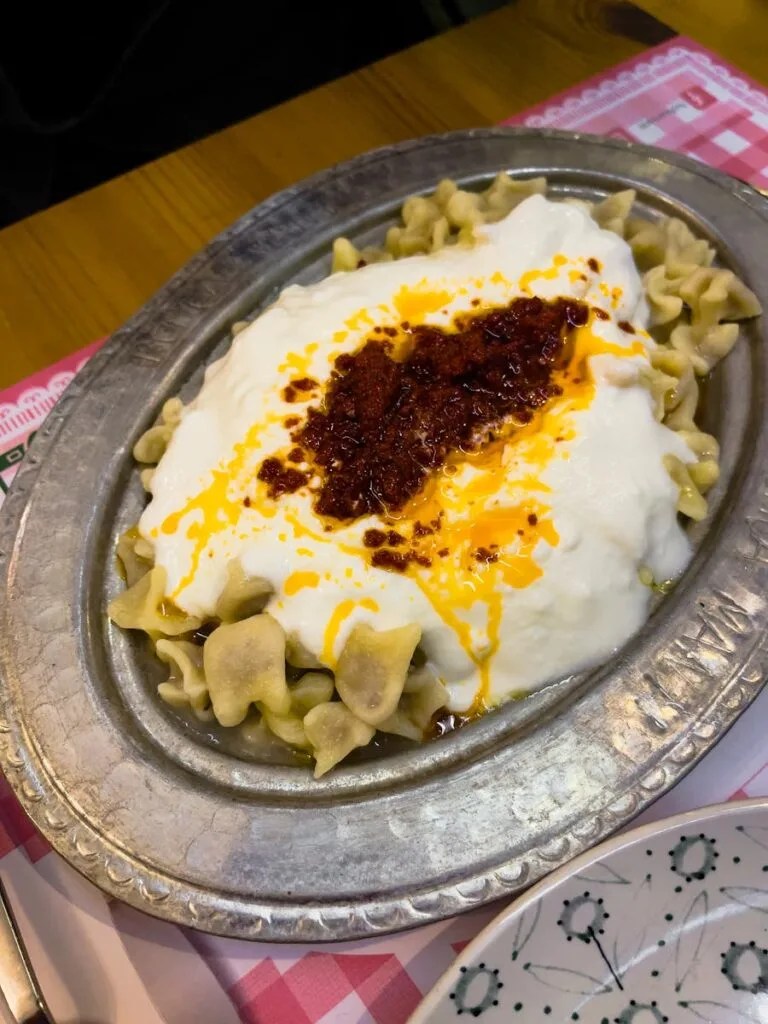
Undeniably, the most famous manti in the world is indeed the Kayseri style Turkish ones – small meat-filled dumplings topped with yogurt and spiced butter. However, a multitude of regional and cultural variations exist not only across Turkey but also beyond. The locals from Kayseri jokingly boast of their dumplings’ being so tiny that 40 of them should fit on a single spoon.
On the other hand, Boşnak mantısı (manti of Bosnian type, also popular in neighboring Serbia and Croatia) is of a notably bigger size, more rectangular, and grilling is the preferred cooking method instead of boiling. These are commonly served with only a garlic yogurt sauce and a dash of sumac on top.
Another example is Sinop mantısı, coming from the Black Sea region, which is normally covered with crushed walnuts in addition to the traditional yogurt and butter sauce. In some places of Eastern Anatolia, instead of meat, lentils or chickpeas are used, and those vegetarian versions of manti can also include spinach, mashed potatoes, or pumpkin as ingredients.
Traveling to Central Asia, Tatarstan, and the Caucasus, this beloved dish transformed once again—into Uzbek manti(much bigger, steamed dumplings) and Armenian mante, which are baked until golden, and then dunked in broth.
Even the sauces could be different: in some places, butter is replaced by tomato paste, and in other cases, the yogurt is added with mint or sumac.
Preparation Tips


Making Turkish manti at home can be very challenging for a person who has never done it before, but smart tips may turn the process into a more interesting and less exhausting one.
The first thing that you should do is not to rush—manti is a dish which requires slow preparation. Widespreadly, families make a lot of manti and then store it in the freezer to be used later. So, you can make twice as much as you need and freeze half of it.
To make the dough more stretchable, let it rest for at least 30 minutes before rolling. Roll the dough, but do not make it thin like paper—about 1–2 mm thick is the best thickness.
The most important thing that should be considered while making the filling is the use of very finely ground meat, but don’t stuff too much of it—only a pea-sized amount for each dumpling.
Make sure the squares are sealed tightly so that the filling doesn’t leak while cooking.
If you are boiling them, add salt to the water and be careful when stirring so as not to break the manti.
If you are frying them, greasing helps retain the crispness of the dumplings.
How to Serve Manti (and With What)

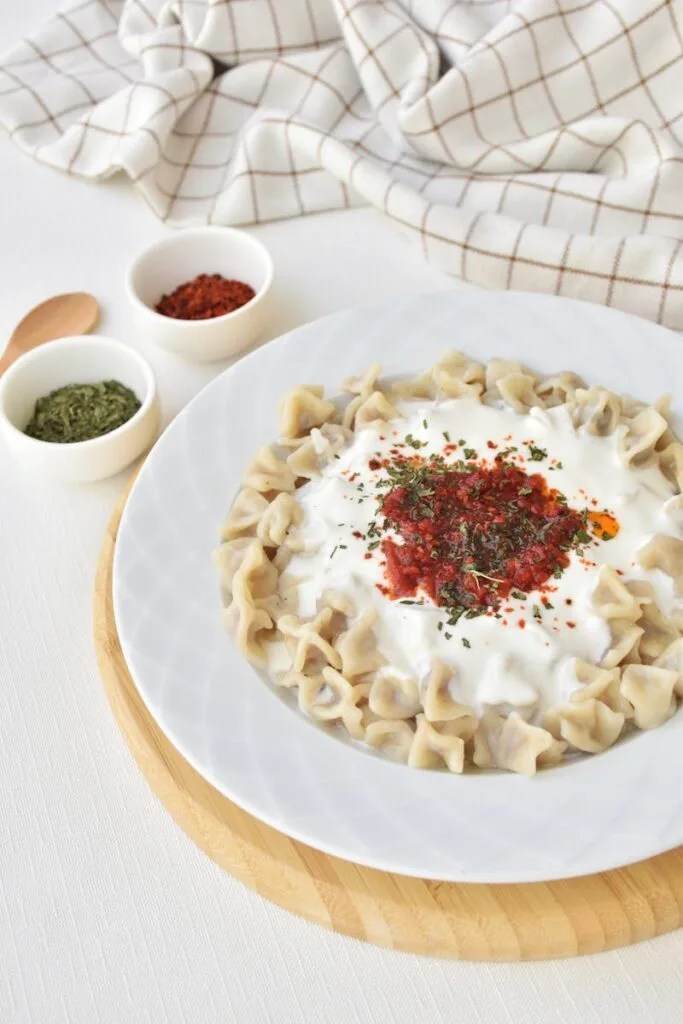
Manti is always served hot and always with its signature toppings. The classic trio consists of a copious quantity of plain yogurt, garlic, either minced or mashed, a small quantity of melted butter, and paprika or hot pepper and dried mint.
Usually, manti are served as the main dish, not as a side. It alone is very filling, especially if it is accompanied by a salad, like çoban salatası, or another side dish (like dolma, mucver, or sarma) or a Turkish soup.
Moreover, in the regional versions such as that of Erzurum or Eastern Anatolia, manti is offered in a warm tomato-based broth instead of yogurt, kind of resembling a dumpling soup.
As for beverages, the ayran (a salty yogurt drink) or a glass of cold mineral water are the best partners for the dish. If you have a sweeter drink, the richness of manti will not go well, so it’s better to choose fresh drinks that have a cleansing effect on the palate.
Enjoying this post? Then you may also like some of our other Turkish recipes like iskender kebab, doner, borek, pismaniye, and simit.
Storing
If you intend to cook manti within the next 24 hours, it is okay to keep the shaped, uncooked dumplings in the fridge in a sealed container.
Freezing is also a suitable option if you need to store the manti for longer periods. Just put the raw manti on a tray in a single layer and freeze to solid in a way that the dumplings won’t be sticking to each other. Frozen manti stored in the fridge remains good up to 3 months.
The situation with cooked manti, on the other hand, is different, and you shouldn’t keep them in the fridge for more than 2 days.
A Few Things You May Need

Mixing Bowls


Baking Tray


Rolling Pin
Turkish Manti Recipe


In this article, we'll share the traditional Turkish manti recipe and teach you everything there is to know about these delicious dumplings, including its origin, variations, preparation tips, serving tips, and more.
Ingredients
For the Dough:
- 2½ cups (300g) all-purpose flour (plus extra for dusting)
- 1 large egg
- ½ tsp salt
- ½ cup (120ml) lukewarm water (adjust as needed)
For the Filling:
- 250g (½ lb) ground beef or lamb
- 1 small onion, finely grated or minced
- ½ tsp salt
- ¼ tsp black pepper
- Optional: ¼ tsp paprika or ground sumac
For the Yogurt Sauce:
- 1½ cups plain full-fat yogurt
- 1–2 cloves garlic, finely minced
- Salt to taste
For the Butter Sauce:
- 3 tbsp butter
- 1 tsp paprika or Aleppo pepper
- Optional: ½ tsp dried mint or sumac for garnish
Instructions
1. Make the Dough
- Mix flour and salt in a large bowl.
- Put the egg in, then gradually add lukewarm water while you mix with your hand or a spoon until a dough forms.
- Knead for 8–10 minutes until it becomes smooth and elastic.
- Cover it and allow it to rest for 30 minutes.
2. Prepare the Filling
- Combine ground meat with grated onion, salt, pepper, and spices in a bowl.
- Mix it well, cover it, and let it sit in the fridge until you use it.
3. Roll and Cut the Dough
- Divide the dough into two parts on a floured surface.
- Roll out one part into a thin sheet (1–2 mm thick).
- Using a knife or pastry cutter, cut the dough into squares of 3 cm (1 inch) each.
4. Shape the Manti
- Put a little filling (about the size of a pea) in the middle of each square.
- Join the two opposite edges and pinch them so that the empty corners will be sealed and form a small dumpling.
- Do this with all the rest and also spread them on a floured tray so that they will not stick.
5. Cook the Manti
- Heat a large pot with salted water till it boils.
- Put manti in the water and cook for 7–9 minutes till they float and are soft.
- Remove and keep for a short time.
6. Prepare the Sauces
- Mix yogurt, garlic, and a pinch of salt in a bowl.
- In a small pan, melt butter over low heat. Add paprika (and optionally mint) and stir for 30 seconds until fragrant.
7. Assemble and Serve
- Place manti on a serving plate.
- Spoon over the garlic yogurt.
- Drizzle with hot butter sauce.
- Garnish with mint, sumac, or chili flakes, serve, and enjoy!
Nutrition Information:
Serving Size:
15-20 piecesAmount Per Serving: Calories: 480Total Fat: 24gSaturated Fat: 9gTrans Fat: 0.2gUnsaturated Fat: 11gCholesterol: 82mgSodium: 420mgCarbohydrates: 45gNet Carbohydrates: 45gFiber: 3gSugar: 3gSugar Alcohols: 0gProtein: 22g
How did you like our Turkish manti recipe? Did you try to make it at home? If you did, don’t forget to leave us a rating and let us know how it went.
Like it? Pin it.

