
Chechen cuisine is one of the least known jewels of the Caucasus; because of the region’s unique geography that allowed its people to preserve their culture and identity over the years, it’s very different from Russian, Georgian, Dagestani, and all other neighboring cuisines. The food here, as the people who live there, is diverse, warm, and filling. From hot chorbas, dumplings, stews, or roasted meat to fragrant breads like khychin and chudu, Chechen food has a lot of surprises, and in this article, we’ll cover some of our favorite Dagestani dishes.
A Few Basic Facts
One of the reasons why Chechen food is simple is that the way of cooking that is cooked is quite simple. While Russian peasants, who had equally limited diets, used the great Russian stove that allowed slow cooking and thus flavors came together, the Chechens used an open flame to cook their food quickly, a typical trait of the traditional nomadic lifestyle of the alpine shepherds.
As Chechen food is distinct from Russian cuisine, it is also quite different from that of Georgia, its southern neighbor. The first thing that comes to mind is that no city in Chechnya could compare with Tbilisi, a major city that lies astride important trade routes.
The Chechen territory, however, being repeatedly invaded and occupied, on the other hand, the flow of goods, especially new foodstuffs and spices, was far from abundant to supply the local inhabitants. Chechnya was farther off, and its soils were less fertile. This relative isolation meant that until the mid to late twentieth century—up to the point when Chechen food was gradually influenced by the Soviet system and hence it became somewhat russified—Chechen food stayed almost quite distinct.
Appetizers & Side Dishes
Naturally, we’re starting off this list of the best Chechen food with a few appetizers and side dishes…
Chorpa


Chorpa is a quintessential Chechen meat-based stew usually prepared from bones-in lamb or beef, slow-cooked for a few hours until a broth is produced with a flavour of deep meatiness. It uses vegetables like carrots, onions, potatoes, garlic, and sometimes chickpeas or turnips, with herbs like dill or parsley. The taste is savory and warm with a slight greasiness on the surface. The characteristic of this soup that differentiates it from others is that the broth is quite strong yet transparent, and the vegetables are cut into big, rustic chunks. It is common that the soup is eaten with flatbread like khychin and is usually accompanied by ayran or tea.
To-Beram Cheese


To-Beram is the main product of Chechen dairy cuisine. It’s more of an ingredient than a dish, but it is also a very popular snack/appetizer. It’s a cheese variety produced by coagulating whole milk (usually from cows or sheep) with natural acids like vinegar or yogurt, which gives it a flavor different than both cottage cheese and ricotta, with a slightly sweet flavour. The key feature of To-Beram is its great variety of uses: it can be consumed as it is, be an addition to savory stuffings like khudar (cheese porridge), be incorporated into flatbreads such as chepalgash or dalnash, or be mixed with herbs to make dips.
Siskal


The Siskal Cake is the simplest yet one of the most heartwarming dishes of Chechen cuisine. It’s basically the Chechen version of corn bread that only requires a few ingredients -corn flour, water, and milk. The corn base gives it a heavy, gritty texture, and some people like to add cheese, butter, or honey for a deeper taste. Siskal is the best during the farming seasons as a complement to ayran or kefir, which brings out the natural sweetness and lightness of this simple but delicious corn bread.
Enjoying this post? Then you may also like our guide to Tatar cuisine.
Roasted Ramson (Wild Garlic)


One of the most fabled wild foods of Chechnya is ramson (wild garlic), known by various dialect names all over the region, and one of the most extensively foraged local products in all of Chechnya. These vigorous green leaves that grow freely in the mountain areas during spring are either roasted or sautéed in butter or animal fat and can be served as a side dish or a spread.
Daqina-Jijig


Daqina-Jijig is a meat dish that can be described as the Chechen version of prosciutto. It is made of either lamb or beef that is extensively salted, air-dried, and then smoked, which is usually done by burning wood, so the meat gets a heavily natural wood aroma and a dense, chewy texture. This wood smoking procedure may continue for a few days, and thus, in mountain areas, families are those who provide the smokehouses or chambers for this. Hot or cold, thinly cut Daqina-Jijig is generally the way, along with the garlic sauce, the pickled onions, or the hot bread, such as the khychin, that it is most often eaten.
Enjoying this post? Then you may also like our guide to Uzbekistan’s cuisine.
Breads & Pastries
Pastries, pies, and especially bread are a crucial part not just of Chechen cuisine but also of every single meal…
Manti

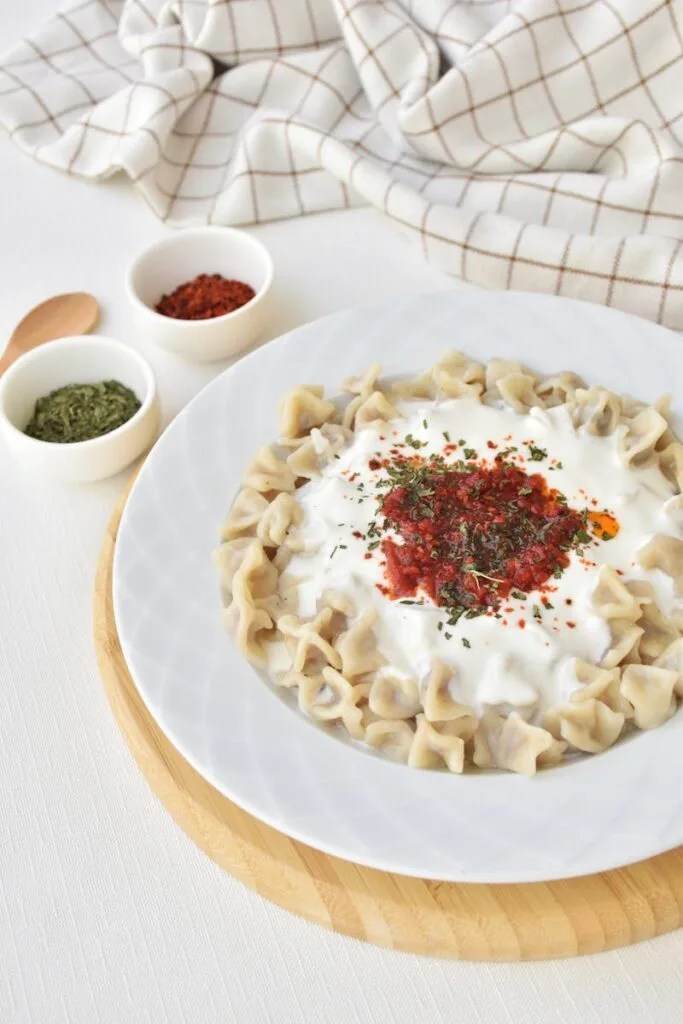
The Turkish Manti is a dumpling dish that can be described as Turkey’s response to Italian ravioli or Chinese wontons, although it has a different taste. The main ingredients of manti are small dough parcels that are generally filled with spiced ground lamb or beef. Those can be either boiled and then baked, garnished with a yogurt sauce with garlic, and at the end, a drizzle of melted butter blended with paprika, sumac, or dry mint.
The manti is normally very small—it is said that the smaller the manti is, the more love and skills are used to make it. In Turkish traditional households, manti is not just about preparing the food- it’s a social event that mostly involves several generations of people who are folding the dough together at the kitchen table.
Khychin


Khychin is a local flatbread famous all over Chechnya and the Caucasus. It’s also known as “sun bread” because of its shine after being brushed with butter while it was being baked. Cobbled with an easy unleavened dough, the duo of smooth and crisp bread embraces the savory fillings- the most popular ones include mashed potato and finely chopped onion, while other options include farmer’s cheese or minced meat.
The dough is flattened into a round shape, and then the filling is spread on the dough before baking. After baking, the outer side turns golden and a little blistered, whereas the inner part becomes soft and flavorful by steaming. After the task is accomplished, hot khychin is usually cut into slices, each piece of which is brushed with melted butter and sprinkled with some herbs it is served warm.
Chepalgash


Chepalgash is basically a Chechen stuffed flatbread made from flour, water, and a pinch of salt, and then rolled into thin slices and finally filled with local fresh cottage cheese and finely chopped wild garlic, also known as ‘ramson’. This wild garlic is a spring product that grows in the Caucasus in large quantities, and therefore it significantly contributes to the flavor of the chepalgash, but it also gives it a mellow, slightly garlicky taste. After the filling, the bread is folded, pressed flat, and fried in a pan until golden all over.
Enjoying this post? Then you may also like our guide to Siberian food.
Dalnash


Dalnash is a savory traditional Chechen pastry/flatbread that has a lot of similarities with chepalgash, but it’s a more flavorful and richer version of it. Traditionally, it is made with lard or rendered beef fat mixed with wild garlic or leeks. A dough of wheat flour and water is rolled thin and then stuffed or layered with the mixture of garlic and fat before it is baked or pan-fried after being folded. As a result, during cooking, fat dissolves in the dough and forms a crispy golden crust with a highly aromatic interior. Dalnash is the epitome of comfort food in Chechnya.
Kurzanesh


Kurzanesh is a bite-sized steamed dumpling made by using a soft unleavened dough to wrap around a filling of minced lamb or beef mixed with finely chopped onion, salt, and pepper. The dumplings, shaped like small parcels, are either gently boiled or steamed until tender, then they are usually dipped in a garlic-flavored yogurt sauce or melted butter before serving. Because they are small, hungry eaters often enjoy dozens in a single sitting, usually sharing from one big platter. It’s served while hot, with a crisp herb salad or pickles on the side.
Main Course
Now, we’ve gotten to the meat and potatoes of this guide to Chechen food (both, literally, and figuratively)…
Shashlik


Shashlik is Chechnya’s local name for the skewed, charcoal-grilled meat – a dish that defines most local plazas, open-air gatherings, and family festivities across the region. Usually, shashlik is made from lamb, but you can also find beef versions. The meat is cut into small cubes, marinated in a mix of onion, garlic, salt, coriander, and sometimes a little vinegar or kefir.
Then the pieces are put on metal or wooden skewers and cooked over glowing coals. The process results in meat that is crispy on the edges, tender inside, and infused with smoky, rustic flavor. Shashlik is traditionally served straight from the skewer onto a shared plate with thick flatbread—such as tandyr nan or khychin—raw onion slices, fresh herbs, and a simple garlic-yogurt sauce.
Khudar


Khudar is a unique Chechen comfort dish—a creamy, savory cheese porridge that combines fine grains and melted cheese into a hearty bowl of warmth. Made from corn or wheat meal, cooked slowly in boiling water or broth until thickened, and topped with melted to‑Beram cheese and butter, this is one of the tastiest “poor man’s dishes” you’ll ever come across. The final result is luxuriously smooth and rich, with a mild tang from the cheese and a velvety texture that clings to the spoon.
Zhizhig‑galnash

Zhizhig-Galnash is a dish that is originally from Chechnya but is equally beloved in Dagestan. The name of the dish literally means “meat and dumplings,” not a very creative way to name it, but that doesn’t take anything away from its spectacular flavor.
The dumplings are small pieces of dough that are hand-rolled and then cooked in hot water until they become firm, while the meat—usually lamb or beef—is cooked separately by boiling until it becomes soft and in the end, everything is served together with a hot garlic sauce and sometimes broth on the side. The dumplings are sticky-chewy with a bit of irregular shapes (a sign of handmade care), and the meat is very soft to the extent it comes apart in the mouth.
Holtmash


Holtmash is a simple rustic dish made of small dumplings, but these are different because they are made from cornmeal. The other parts of the recipe are not so unusual- the dumplings are usually filled with fresh nettles or any other spring greens that have been freshly foraged. Traditionally, women in households make holtmash in large amounts in spring, at the time of the year when wild nettles are the most flavorful. The dumplings are shaped into small triangles or crescent forms and boiled until soft. They are generally eaten with melted butter, sour cream, or yogurt sauce and sometimes even topped with a mild, crumbly cheese.
Yokh Sausage


Yokh sausage is one of the lesser-known but most distinct specialties of Chechen cuisine. The only similarity between the making of yokh and the usual sausages is the use of meat. However, yokh is a one-of-a-kind mixture of ground mutton, chicken fat, wheat flour, garlic, and spices, which is put into a natural casing after mixing. The use of flour in the mixture gives the sausage a soft and slightly dense doughy core, which is perfectly balanced with the meat’s fatty aspect.
After assembling, the sausage is cooked by steaming or poaching and then frying (lightly) just before serving. The result is a delicious sausage which is chewy and packed with different textures, including the crispy casing, smooth flesh, and slightly spicy interior (from the garlic and spices). Generally, warm and sliced, yokh sausage goes well with corn porridge, flatbreads, or even yogurt sauces on the side.
Kiald-Davtta


Kiald-Davtta is the main food during festive occasions, and it’s an indispensable part of Chechen cuisine. The dish is made from internal organs of an animal, including sautéed liver, heart, or kidneys, mostly from lamb or beef. I know it doesn’t sound the most appetizing, but it’s one of those dishes that you’ll find delicious if you don’t know what it’s actually made of. The pieces of meat are finely chopped and seasoned with onions, garlic, salt, pepper, and sometimes wild herbs, and then they are pan-fried in animal fat until the outer surface gets caramelized and the inside remains soft. The final product is a rich and intense meaty flavor dish of different textures—crunchy edges and juicy centers.
Kkherzan-Dulkh


Kkherzan-Dulkh is a special Chechen dish that people usually make when they have big celebrations or special events. It is a dish whose preparation takes a lot of time; the meat of choice is lamb or beef, and it’s mixed with grains like millet or cracked wheat, seasoned with garlic, onions, and black pepper. The ingredients are slow-cooked in a large pot until the meat is tender and the grains have absorbed the broth. The final result is thick, salty, and satiating—kind of like a combination of risotto and pilaf, but with a more rustic texture.
Rice Pilaf


Pilaf is a dish that originates from Central Asia/Middle East (it’s kind of hard to draw the line because it’s so popular in all of these countries) that was introduced to Europe by the Ottomans. The Moldovan version of pilaf includes cooking long-grain rice in a mixture of a hearty broth, spices, and chunks of meat, usually lamb, but you can also use pork (there’s a joke that Romanians and Moldovans have taken a lot of Turkish dishes and used pork meat instead of the original ingredients) and chicken too. The final result is a version that resembles Asian fried rice, usually served alongside pickled vegetables or a fresh salad.
Desserts
This list of the best Chechen food wouldn’t be complete without at least a few sweet treats, starting with…
Akhar Khovla


Akhar Khovla is a very popular Chechen sweet made from wheat flour, made by gradually roasting flour in butter or fat until it becomes golden brown and develops a nutty smell. After the roasting is done, the mixture is combined with sugar or honey. The halva is quite dense and a bit crumbly; however, it is packed with flavor, sweet with a hint of tart, and very comforting. Usually, Akhar Khovla is served in pieces, usually on special occasions, such as religious holidays or weddings.
Dema Kholva


Dema Khovla is another Chechen halva variety made with yogurt. It’s a dessert that embodies the gentle sourness of the fermented milk and the richness of the dairy in a warm, sweetened form. The main difference between Akhar Khovla and Dema Khovla is that the former is only made of flour and fat, while the latter combines the yogurt (or sometimes sour cream) with the toasted flour base, resulting in a flavor of creamy and slightly sour. Typically, it is prepared by slow-roasting flour in butter or animal fat until it gives a pleasant aroma, then the yogurt and the sugar are added until the mixture becomes thick like a soft paste.
Gvaymakkhsh


Gvaymakkhsh is a delicious Chechen dessert that can best be described as the Chechen version of a pancake. The batter for the pancakes is made of flour, eggs, milk, and sometimes yogurt, which gives the pancake a mild sourish note that is tender in texture, and if fried on both sides until golden brown. Before serving, the sweet is brushed with butter or ghee and topped with soft cheese, jam, or honey, depending on the occasion.
Vieta


Vieta is a traditional Chechen delicacy that consists of corn, dried or fermented. It is one of the most versatile dishes in Chechen cuisine- it can be eaten as a snack, a dessert, or even a main dish during fasting or Lent. Vieta is frequently combined with melted butter, sour cream, or chopped dried fruits or nuts. Some areas in the highlands prepare it with milk or whey to make it creamier.
Drinks
Last but not least, here’s what people in Chechenia usually drink alongside their hearty dishes that we previously presented above.
Kefir


Kefir is a fermented dairy drink made of milk from a cow or goat. It has a sour flavor, a slightly sparkling texture, and it’s very popular in Eastern Europe and the Caucasus. Chechen kefir is known for its peculiar local twist; it’s usually a bit denser, more acidic, and sometimes it is prepared using old fermentation methods that have been handed down from generation to generation. The grains are usually kept in cloth or wooden containers and are cared for as if they were sourdough starters. It is normally taken in the morning with flatbreads or after a heavy meal to aid digestion.
Ayran


Ayran is a traditional yogurt-based drink with a salty flavor made by mixing yogurt, cold water, and a small amount of salt. It’s usually consumed during the hot summer months or to refresh the palate after meat-heavy meals like shashlik or zhizhig-galnash. One thing that makes Chechen Ayran different from its Turkish or Balkan cousins is usually the consistency— a bit thicker and more sour with a richer yogurt taste.
Churychay


Churychay is traditional Chechen tea made by steeping black tea leaves and seasoning the brew with black pepper, cardamom, cloves, and sometimes bay leaf or dried herbs. Some variations include adding milk or salt, and it is usually served in small cups. Offering it, in many cases, is the first gesture of hospitality towards a guest in a household.
How did you like this guide to Chechen food? Did you try any of these dishes before? Feel free to share your thoughts in the comments below.
Like it? Pin it.


abd
Monday 15th of December 2025
bad boi amira made the food for